ב"ה
Mendel was just seven years old when his father suddenly passed away, leaving behind four orphans. The Rebbe took a unique interest in the Scharf children, showering them with attention, love, and paternal concern – which we can all learn from. Watch Rabbi Scharf share his story, and the lessons and inspiration he continues to carry with him more than 30 years later.
Letters and Numbers of Torah - Chukat
Describing the red heifer ritual, the Torah states (Numbers 19:2) “Take a red heifer that never had a yoke placed upon it.” The Hebrew word for yoke (ol) is normally spelled ayin-vav-lamed, but in this verse, the vav is missing. What is the connection between 1) the missing vav, 2) the Edomites who are descended from Esau, and 3) the story of Moses striking the rock?
How to Study Torah - Balak
When King Balak hired the evil prophet Bilam to curse the Jews, G-d told Bilam, (Bamidbar 22:12) "Do not curse the nation for they are blessed." But when Balak sent more officers to ask Bilaam again, he told them, (22:19) "Stay here tonight, and I will know if G-d wants to say anything more to me." Why didn't Bilam answer that G-d had already told him not to go? Furthermore, why did G-d eventually allow Bilam to accept the task of cursing the Jews after having previously warned him not to?
Parsha Curiosities: Balak
Balaam’s famous prophetic words “Ma Tovu” occupy a unique place of prominence in the Hebrew Scriptures, our daily prayers and Jewish liturgical compositions. Oftentimes even emblazoned on Holy Ark’s and Synagogue facades, they clearly contain many marvelous mysteries and secrets. Following a general intro, we initiate analysis of Rashi’s seemingly lackluster elucidation, which leads us into a journey of profound discovery as we mine the verse to reveal dynamic dimensions of insight. In the end, our return to the primary port of departure resonates with timely and relevant guidance about the singular importance of modesty in our modern age of hyper-promiscuity.
A Metaphor for Exile and Redemption
Before the siege of Jerusalem, G-d commanded the prophet Ezekiel to place an iron pot around a brick symbolizing the city's siege. (Ezekiel 4:3) Iron can be a metaphor for the grave character defect of rigidity or for the deep inner strength of the Jewish people that leads to Redemption.
Letters and Numbers of Torah - Pinchas
"Pinchas...has turned My anger away from the children of Israel by his zealously avenging Me... therefore I hereby give him My covenant of peace." (Numbers 25:11-12) In this verse, the letter 'vav' of the word 'shalom' (peace) is written like two separate letters, a 'yud' above and a small 'vav' below. What does this teach us about how to make true peace?
Letters and Numbers of Torah—Matot
G-d tells Moses, “A thousand for each tribe, a thousand from each tribe, from all the tribes of Israel you shall send into the army [to battle the Midianites].” (Numbers 31:4) The Hebrew word for thousand is “elef,” which is spelled the same as “alef.” What is the connection between the battle against Midian, the letter alef, and the Three Weeks of mourning over the destruction of the Temple?
Parsha Matot-Massei
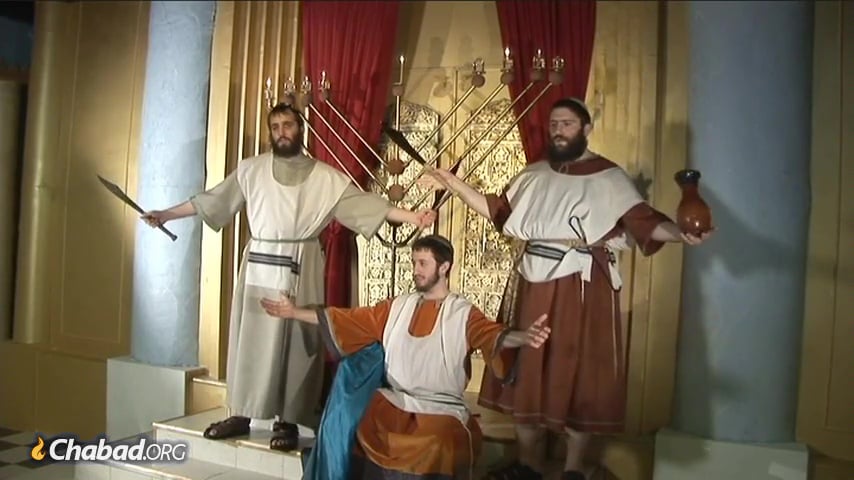
The Torah prohibits constructing the Temple with wood; only stone and brick are admissible. Yet the high priest's chamber, located in the Temple proper, was made of wood. This class will present an analysis of the subject from both halachic and spiritual viewpoints. (Likutei Sichos vol 28, Parshas Massei)
"Studying the dimensions of the Holy Temple is like building it"
The Midrash relates that at the beginning of the Babylonian exile, seventy years before the Jews’ return to Jerusalem, G-d instructed Ezekiel to teach them the dimensions of the Holy Temple, because when they engage in its study, G-d considers it as though they built it.
Study the Book of Lamentations
The Book of Lamentations is a sad song which contains the most heartrending prophecies of Jeremiah about the destruction of the Holy Temple and the ensuing exile. Join us for an informative and uplifting text-based study of this Biblical book, which is traditionally read on Tisha B’av.
Learning Likutei Sichos vol. 33 Shelach sicha 2
The spies were deeply spiritual people with high ideals, yet they were misguided and missed the point. This leads to fascinating dive into the Rambam’s definition of attaining the ultimate level of love of Hashem. A lesson from the spies: The goal of Juda
Guiding behavior while nurturing empathy and self-control
When children act out, it’s easy to feel frustrated or concerned—but what if the behavior isn’t who they are? This final session introduces a powerful approach that separates your child’s identity from their impulses. You’ll learn how to help your child a
Get the Chabad.org Video app