


First published: 2004. Revised: 2026.
Question:
Rabbi, you’ve done the gender-exclusion thing long enough. What may have been okay for medieval Europe just won’t cut it in today’s world.
How much longer do you imagine keeping the synagogue a men’s club? Do you really expect today’s women to be satisfied with the peanut gallery? And the high point of Jewish spiritual ritual—the reading from the Torah scroll—continues to exclude the fair voices of 50% of your membership!
Rabbi, change is knocking on your door, and it’s time to let her in—before the whole building collapses.
Answer:
Change? How about if we adapt instead?
Here’s the difference. To change means to surrender—to give up who you are because the circumstances seem so much more powerful than you. To adapt means to come to a better understanding of who you are and how you are able to meet this challenge.
A Brief, Skip-it-if-you-like, Introduction to Change Versus Adaptation
Each time we adapt to change, we learn more about who we are. Each time we surrender to change, we surrender that power of being who we are. Without a clear identity and cut off from our source, we become impotent, less radical—less capable of effecting real change for the good upon our environment.
Change can be good. After all, change is what Torah is all about. Changing people’s minds. Changing how things are done. Changing the world—into something more wondrous, more glowing, more transparent to its essence. And how have we gone about effecting those deep, radical changes in our world very successfully over the past 3,700 years? Basically, by staying the same.
Actually, your argument for change would have been a much stronger one earlier in history. Let’s say we were living in the times of the Temple in Jerusalem, and you would challenge me, saying, "Why do you people have to do everything so differently than everyone else?" Then I would have had to respond principally out of faith. As in, "Well, G‑d said so, so it’s got to be right."
By now, however, we have the largest sample in the history of trial and observation under every possible social, geographical, economical, political and military condition. Each time, everywhere, anywhere and anytime, Torah worked. No other nation or culture comes close to the record of the Jewish People for continuity across a variegated sweep of history, adapting to every age without surrendering their essential identity. "Hey!" the scientist says, "There’s got to be something to it!"
There is. Torah doesn’t belong to any time, system, society or circumstance. It’s from outside the system. So it works everywhere, as long as we keep looking deeper into it.
Which we do. We even have a name for it. We call it halachah--the Jewish method for adaptation without change. It involves constant reference and coherence with past precedent along with consideration for the communal challenges of the present. Through the process of halachah, we have managed adaptation without change for thousands of years.
Adaptation brings us closer to our essence. When we moved from nomadic society to agrarian to glorious civilization to exile to less glorious civilization to Hellenization to mercantile province to exile again to practically everywhere and everything to industrialization to pop society and now to life in cyberspace—each time we come to a deeper understanding of ourselves and of our Torah.
So, too, today’s challenge of the rise of the feminine in society, driven almost entirely not by some Marxist class struggle, but by technology, including medicine and hygiene. Suddenly, mysteries of Torah are brought to light that would previously pass unnoticed.
Take our behavior in shul. (That’s what we call it. We’ve got to get past this Greek antiquity "synagogue" thing). You describe this behavior as somewhat of an anachronism. This is indeed an insightful observation. We definitely are not part of the present. Put an anthropologist in our shul, observing men wrapped in woolen sheets and leather straps chanting ancient Hebrew from a hand-crafted parchment scroll, and he would be hard put to determine in which age we belong.
Where you err is in your implication that we belong to some era of the past. This is patently false. There was never a time when Jewish practice was in sync with the times. Not in medieval Europe and certainly not anywhere in the ancient world.
When everyone else was having a wild time with goddesses, priestesses, sirens and oracles, do you think it was cool and with-it to have a male-only line-up for our Temple services? In that regard, it would have been the dullest show of its genre were it not for the fantastic daily miracle show and a great soundtrack from the (all-male again) Levite orchestra. Definitely an anomaly then, even more than now.
But there is something very deep about it. Something very resilient. Something that perhaps we still don’t fully understand. So before we take out the knife and scalpel, let’s just examine that mystery a little further. Would you pave a highway through a giant redwood forest before you’ve understood its underlying ecology? We're dealing here with a system of a yet far deeper and delicate complexity.
Back to the Question
You brought up prayer and the all-male minyan. Yes, women can attend services, but all the dominant roles are handed to the men. And women stand on the other side of a partition or upstairs in the gallery. You don’t know just how enigmatic this is. In fact, it is bewildering. Mysterious. Astonishing. Let me explain why:
How do we know how to pray? We learn most of the guidelines for prayer from a lady named Chana who lived about 3,000 years ago, before the First Temple was built.1
Chana2 came to the Tabernacle in Shiloh—the precursor to the Temple in Jerusalem—and prayed for a child. She prayed quietly, her lips moving but her voice audible only to her own ears. She poured out her heart and demanded that G‑d change the natural order of things for her sake, that He grant her not just any son, but a very righteous one, a special one. In return, she would dedicate this son’s life to holy things.
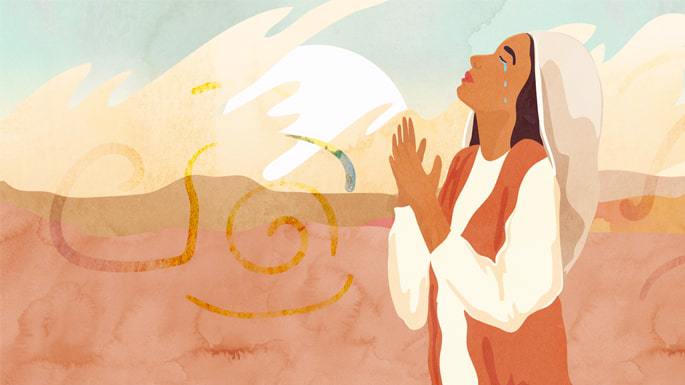
All along, the High Priest of the Tabernacle (his name was Eli) kept an eye on this lady. Then he went over to her and accused her of attending Temple service while inebriated. Chana tells him off quite respectfully by describing the bitterness of her soul, that she is "pouring out before G‑d." Eli takes her words seriously, blesses her, and a year later, Shmuel the prophet is born.
From the story of Chana, the sages of the Talmud learn many things. Including:
- Prayer is a quiet act.
- You still have to move your lips (and hear yourself).
- Prayer is done by pouring out your soul.
- Crying could only help matters.
- You can make deals with the Boss.
- If you beg hard enough, He may even break the rules for you.
- Don’t drink and pray.
In fact, the sages were so enamored with Chana’s prayer, they composed the Amidah (also called Shemoneh Esreh or "Eighteen Blessings"—the mainstay Jewish prayer) using 113 words for all the blessings, just because there were 113 words in Chana’s prayer. Now if that isn't gilding it in gold, what is?
Do you get it? All those guidelines of prayer are to teach men how to pray like a woman!
After all, why did Chana look to Eli (a man) like a drunk? Because her emotions poured out unconstrained. Men have a hard time with that, much harder than women, even when those men really are drunk.
Indeed, the whole modality of prayer is a female thing: Men don’t like to cry, to admit helplessness, to express their inner selves, and discuss their true needs. These are things we generally associate with women. And, by the way, men especially don’t do these things when there are women around. So the guidelines of prayer have to create a framework in which men can do all this.
So, too, you will find that in the Bible, song is generally a female thing. When the men sang to celebrate the crossing of the Red Sea, the women one-upped them, whipping out cymbals and dancing, too.3 The two all-time hit songs of the prophets are the song of Devorah4 and the song of Chana. Even King Solomon’s Song of Songs is set in two voices of a man and a woman, with the woman’s voice predominant.
Let’s look at Kabbalah. Kabbalah is traditional Jewish theology. Consistently, you will find the Kabbalists describing the entire cosmos as a dynamic balance of the masculine and feminine elements and energies.
In Kabbalah, prayer is considered to lie in the feminine element. The Mother Of All Life strives to return Above, carrying all her world along with her.5
The feminine element is called by our sages "the Shechinah," meaning an indwelling or presence. How G‑dliness invests itself within the creation to give it life and existence. In the language of Kabbalah, this is called "Malchut," meaning royalty. You’ll also hear it called, "the Queen," "the Divine Word," "the cosmic soul" and "the permeating light." All refer to an immanence, as G‑dliness is found within all things.
When we speak, on the other hand, of G‑d as "He"—"the Holy One, Blessed be He," "the Father," "the Encompassing Light" and such—we are speaking of G‑dliness as it is transcendent and beyond. This is the masculine element.
We say that "G‑d is one and His name is one"6—meaning that these two elements are only two modalities of a single entity that cannot be known or grasped in any form. Prayer, however, is a drama whereby the feminine element feels a separation and strives to mend it.
Now you can see it’s not just puzzling; it’s downright bizarre. Song and prayer is principally a woman’s thing, yet the shul is the domain of men!
Organized Religion
Of course, the difficulty is only if you insist that the shul is all about prayer. But it isn’t.
The shul is a very good place for prayer. Even if there’s no minyan, you’re better off praying in a shul than at home. But that’s not what a shul is. What it is is a miniature clone of the original "Beit Hamikdash"—the Temple that once stood in Jerusalem, may it soon be rebuilt. That Temple was also a great place to pour out your heart in prayer. But no one ever suggested that prayer is its central theme. The central theme of the Temple is something related, but quite different: That space should be holy.7
Here again is that balance I was talking about—the masculine and the feminine. Prayer is feminine, but temples are masculine.
Let’s go back to that story of Chana in the Tabernacle. Chana also thought the Tabernacle was a great place to pray. And her prayer proved, in fact, to be quite efficacious (it worked). But—hold on—only after a brief meeting with Eli. And only after receiving his blessing.
Eli, you recall, was the High Priest, the Mr. Holiness of the Tabernacle operation. He was also the man who mistook Chana for a drunk. How does a holy man, steeped in the Divine mysteries of the Temple service, only two generations removed from Mount Sinai (Aaron—>Pinchas—>Eli), how could he possibly mistake the ultimate prayer for its diametric opposite—a drunken stupor? After all, a man such as Eli sees with more than his physical eyes.8
So you have to keep in mind that Eli was running a tight operation here. A Holy Tabernacle. Where services run seven days a week, 365 days a year, always on schedule, always strictly by the book, precisely choreographed and tightly supervised. Got a sin-offering? Here are the rules. A guilt-offering? Different set of rules. Just want to show your thanks and appreciation to the Almighty? You better follow the rules for that one as well, or else you’ll be back to the sin and guilt package.
There are morning offerings, afternoon offerings and evening smoke-pillars. Sure, there’s the music and colorful festivals as well, but all go by the book. That tight choreography is meant as a vehicle for inspired action, meditative focus, cleaving of the soul to its Divine Source in sublime ecstasy, but don’t let any of that disturb the underlying order.
I’ll give you an example: When it comes to the instructions for the lighting of the Golden Menorah in the tabernacle, the Torah tells us, "And Aaron did just what G‑d told Moses he should do."9 And, the sages comment, this is praising Aaron, that he didn’t make any changes.
Hold it: This is Aaron, brother of Moses, the first and ultimate High Priest of all time. He’s going to make changes in G‑d’s explicit instructions? This is how you praise Aaron, that he follows the rules?
Yes. Because Aaron understood and was eminently conscious of all the implications of this service in worlds spiritually higher and higher and way beyond our own, all the way up to the Infinite Light. He saw the connection between these lamps that he lit and how they drew that supernal, unbounded light down through all those worlds to enlighten and elevate megahosts of angels, seraphim, souls, you-name-it, all the way down to the world he was standing in. At the time he performed the lighting ceremony, he was in a deep meditative state, pondering all this, his heart pounding, his soul soaring above and his mind on the verge of explosion.10
Now imagine sticking to the instructions in such a state.
But that’s how Aaron understood his mission: To contain that fire in a hi-definition, earthly performance. And so did Eli.
In Kabbalistic terms, Eli’s job was to fit unbounded light into the boundaries of time and space. Spontaneous outbursts and outpouring of the soul were just not part of his world.
It may have been in an earlier time. And it certainly was in the times of King David—his psalms reveal a soul of explosive, uncontainable passion. But it seems that in the time of Eli a bit of decadence had set in. The balance between unbridled passion and strict order had been lost with a preponderance of regulated, predictable ritual. Too much containment, not enough light—as the Kabbalists would put it.
So Eli says to Chana, "You’re drunk." And she enlightens him a little, brings back memories of how things are really supposed to be. And he gets it. So he gives Chana a blessing. And then, only then, does the prayer work.
Why? We understand why Eli needs Chana. But why does Chana need Eli? Isn’t her prayer good enough without him? Apparently not. Apparently, even the ultimate prayer is not good enough alone. Because prayer alone is a rocket ship without a landing mechanism. And what goes up must come down.
Traffic Control
Remember Jacob’s ladder?11 Jacob slept at the place where the Temple was eventually to be built. In his dream, he saw a ladder firmly grounded on the earth and reaching up to the heavens. Angels climbed up the ladder to heaven while others returned down to earth.
The Zohar tells us this ladder is the ladder of prayer.12 A two-way express conduit connecting the earth with the heavens and the heavens with earth.
First, you go up. All the way up. Prayer, like everything else Jewish, is a gambit to break out of the system. Better: To break the system out of its system. To take all the concerns of daily life and raise them higher and higher to a place that has none of the limitations of the system. A place where anything and everything could happen, where an entirely new direction of events could be authored. To reach to the Author of the system and get Him to create a "new will"—like we say in so many of our prayers, Yehi ratzon milfanecha... "May it be Your will (literally: May a will come into being from before You) that ... "
A new will? There’s nothing new under the sun, said wise Solomon. So if you want to create a new will and really change things, you’ve got to reach higher than the sun.
Which is just where the ladder of prayer reaches: Beyond the sun. Beyond the whole system. That’s where Chana climbed in her prayer—all the way to the top of that ladder. And her whole life changed from it. Which is why the best we can do is to emulate her.
But she still needed Eli’s blessing. Because a blessing does something a prayer cannot. True, a blessing doesn’t reach as high as prayer. A blessing doesn’t create anything new, either. But a blessing captures that new will created up in heaven, gives it substance, packages and shrink wraps it, and brings it to a safe landing down on earth.
That is what the shul is about. Like Aaron lighting the menorah, the shul is a place to bring spirituality within time, space and words. That’s why you try to say your prayers there, if you can. Because prayers said there have a better chance of bearing fruit. Of making a safe landing.
Bipolar Order
"... because at the foundation and origin of the entire Torah lie two ideas: To lift the soul beyond its embodiment, higher and higher until the essence and origin of all worlds; and also to draw downward the Light of the Infinite One, may He be blessed, upon the Source of All Souls [the Shechinah] ... "
-- Tanya, chapter 32.
Torah is full of this two-way process.
- The Temple had Kohanim working (order, drawing down) while Levites were singing (inspiration, climbing up).
- The Jewish people were led out of Egypt by Moses (who brought the Torah down) and Aaron (who brought the people up).
- Our legal system is a resolution and harmony of the school of Hillel (down to earth) and the school of Shammai (up to heaven).
- We study Torah (bringing G‑dly wisdom down to earth) and do mitzvahs (bringing earthly things up to heaven).
- In a Torah family, you have a mother (who tells you who you are) and a father (who is supposed to tell you how to be that).
In most general terms, this is the division of roles between men and women. The male role is principally to capture the unbounded, spiritual light of heaven and bring it within an earthly world of space, time and human grasp. The female role is, principally, to discover the heaven hiding within time and space, and set it free.
That is why the Torah frees women from most time-bound responsibilities, such as tefillin, tzitzit, reciting the "Shema Yisrael" on time at strictly set times twice daily, making it to the minyan on time three times a day, etc.13 Because organizing and packaging G‑dliness into time slots is a male thing. Women are already very tied up with time and its cycles. Their role lies more in opening these packages up and extending them beyond time. The woman is the Mother of Life who unpackages life and nurtures it. She is the one who takes the present and ensures it will have a future. Where a man deals with the present, a woman deals with eternity.
Two Hemispheres
That is why the Torah does not discuss a man and a woman as two distinct entities, but as a single whole. "And G‑d created the Adam in His image, male and female He created them."14 The Divine image is neither male nor female but the synthesis of both. In the world of Torah, a man or a woman alone is half a person.15 Not just in soul, but in body as well.
When G‑d says, "Be fruitful and multiply,"16 He is speaking to Adam as a whole.17 Only that the male half of the Adam gets involved in his male way and the female half in a very different (and somewhat more significant) way. So, too, with every precept of the Torah. G‑d says, "Wrap on those tefillin!" He is speaking to the whole Adam. But on which arm do those tefillin go? The same Torah that tells us they go on the weaker arm18 (for most of us, the left), tells us it goes on the male half of the single male-female body. After all, why should one body wear two pairs of tefillin?19
This also explains another distinction between gender roles in Torah: Where the man has a command to do a mitzvah, the woman often has a mitzvah, but no command. Like in this mitzvah of having babies (which happens to be the first mitzvah in the Torah). The way our tradition reads it, the man is commanded. G‑d tells him he must procreate. The woman is not commanded. It’s optional. And yet, she has nine months of the mitzvah, plus most of the nurturing. Not much room to compare there.
So, too, in many other mitzvahs. Like hearing the shofar on Rosh Hashanah, sitting in the sukkah on Sukkot, studying Torah and more. A man must do these things. Women take it on voluntarily. Most of prayer is this way as well: Women have a minimal requirement in prayer, with no obligation to get to the minyan. What men are required to do, women take it on voluntarily.
A man conquers, therefore G‑d deals with him by conquering by commanding him to do. A woman carries the world upward spontaneously, from within. Therefore, her mitzvahs come as a natural response, from within.
In existential terms: there is doing and there is being. The man is about the causative — making something be. The woman is about being and discovering that which is.
Oppression and Liberation
So the whole of Torah can be summarized as a unity, harmony and synthesis of these two cosmic forces: the masculine and the feminine. Until now, the feminine side has been derided, but that is changing. Until today, it was just obvious that muscle power, fighting wars, conquering the world and massacring the enemy was so much more glorious than creating and nurturing life.
Oy! A flashing memory! Fourth Grade. Old Mrs. Macdonald teaching history. Laura Brown asks, "But weren’t there any great women in history?"
"Of course!" answers Mrs. M. "There was Joan of Arc! And Queen Elizabeth! And Catherine the Great!"
Why were they great? Because they fought wars, like men. (True, the Bible tells of a woman named Devorah who told the warrior, Barak, to make battle with the oppressor. But when Barak demanded that Devorah come along, boy did she give it to him over the head.)
Still today, many women cling to the notion that liberation means the privilege to act like a man. As one male psychologist put it, such women lack ambition.
"In the messianic era," the Kabbalists tell us, "the feminine will rise much higher than the masculine." That attitude has already begun to emerge, as feminine energy becomes an increasingly valued element of our society. And only once it is valued can there be a meaningful synthesis of the male and female paradigms.
Take our shul for example. The place is in desperate need of feminine values. The men have forgotten how to pray. They’ve lost contact with the feminine inside them. But the last thing we need is for women to take it over. Because then, two things will happen:
- The men will leave it up to the women and we’ll never see them again.
- The women will get into all the technicalities of the synagogue prayer protocol and become like men.
It’s like working with fire and water: Put them together, and all you get is a lot of steam and big fizz. Either fire wins, or water, or neither. But keep each in its place with a utensil in between — the water in the pot and the fire under it — and now we’re cooking.
The Real Question

So what is a woman supposed to do? I’m getting to that, but I still haven’t explained what prayer really is.
I want to ask you seriously: Did you ever really think that prayerbooks + ten men + shul + Torah reading = prayer?
If so, I’ve got news for you: I can teach you how to chant the entire Torah in perfect tune and all the shul protocol of who gets shishi and which haftarah to read. I can teach you the kaddish, the kedushah and barchu too. I can teach you the entire prayer book, including the meaning of each word and every prayer, from the simple meaning all the way down to the kabbalistic, inner meaning. I can teach you to contemplate the greatness of the Infinite Creator to whom we pray— and I haven’t taught you the first thing about prayer.
Because prayer simply can't be taught. Prayer is not something you do. Prayer is something you have to be. Like King David says over and over in his prayers, "I am a prayer."20
So what’s the whole liturgy thing about? It's about setting the table. About which dishes go out first and which second and third and where you put the little forks and where you put the big forks and all those very important details. But if there’s no dinner to serve, all that pretty china and silverware is going to look awful lonesome.
Or, back to our original context: All those words and ceremonies are about bringing spiritual energies down to earth. The sages and prophets who composed them knew exactly what needs to be brought down and in what order. But if nobody climbs up there and flips a switch to begin with (i.e., pours out their soul to the One Above), we’ll be milking a dry cow.
The System
Now let me explain how the system works:
The Torah never says, "Thou shalt pray." But it does say to "serve G‑d with all your heart."21 How do you serve G‑d will your heart? "Simple!" the sages say. "Pray to Him."22
Meaning that when your heart bursts with pain, pour it out to Him. When it yearns, speak to Him about that which you yearn for. When your heart is broken, ask Him to mend it. When your heart feels empty, ask Him to fill it. Wherever your heart is at, whatever it is being, connect that to His Being. Make your heart His sanctuary, the place where you find Him.
This is the essential aspect of prayer, where we make no distinctions of time, place or gender. Every heart can be a sanctuary, any time, any place.
Where we do make a distinction is as follows: Men are told, "Do this sanctuary thing together at these prescribed times with all these words before and after. That way, just as your heart becomes a sanctuary, so we will have a general sanctuary for all our community, to propel all our prayers upward and grant those blessings a safe landing."
Women are told, "Be a sanctuary. Be that at least twice a day. Be that in shul or at home, with us or without us. Your thing is not the institution, not the protocol. Leave the men to their domain so that you can take care of yours."
We find Abraham following a similar logic when he excused himself from a private interview with G‑d in order to take care of his guests. Because, after all, what is the point of coming to receive the Shechinah when you can be the Shechinah?
Sometimes, you need a spiritual boost. Sometimes, you need to join with others to get there. Standing in the ladies’ gallery and singing along with a nice chazzan doesn’t always cut it. So some women get together on the new moon or once a week to study and sing and dance together.
It’s not really an innovation, but it works for us today. The women who do it will tell you it works wonders. They don’t need the trappings and protocol of the shul. They just need their souls and their voices. Perhaps their high will spill over into our shul and lift us up, as well.
The Unauthorized Prayer
Perhaps in this way, we can explain another fascinating puzzle: Chana’s prayer, the paradigm of all prayers, was a prayer for a child. Look through your entire prayer book, you won’t find a prescribed prayer to ask for a child. For health, for wealth, for rain, for dew, for wisdom, for redemption, for justice — for everything else. But not for a child.
There are some beautiful prayers to ask for a child. They won’t be found in the standard prayer book, however. They were composed by women in their mother tongue and they are the most heartfelt prayers there are. But no respected rabbi would dare meddle in this domain — the domain of the woman, who brings life into being. And no one would dare prescribe the words to say and the order to say them. Because in the woman’s world, prayer comes from inside and pours outward.
Her Voice Yet to Come
As far as the separation and partition for the purpose of prayer, that is something eternal. It has always been this way, and it must always be so. Even when Isaac and Rebecca prayed for a child, the sages tell us that Rebecca prayed in one corner of the room, and Isaac in the other.23 It was this way in the Temple in Jerusalem. Because it is Torah, and Torah is eternally true.24
The power of male and female is sustained by their separation at times such as these. Even if men were not distracted from their prayers by the presence of women, and women by the glances of men, even if it were possible for them to cry and speak candidly to their Creator, the energies and their directions simply don’t mix.
But when it comes to a woman’s voice, there is a deeper perspective to all this: This is galut. Exile. The Shechinah is in captivity, not in her place, ignored and despised. And she is quiet there. But in the world-yet-to-come, the messianic era that we are poised to enter, then we will hear, "Once again in the cities of Judah and the streets of Jerusalem, the voice of joy and the voice of rejoicing, the voice of the groom and the voice of the bride."25
The Shechinah will sing once again.26






Shalom everyone! I'm following this fascinating conversation, but haven't been able to finish. As was pointed out by some, changes in the secular world have affected the Jewish world, and this is from G-d. As a woman who started the journey of learning Torah at 16 and is now approaching 70 thank G-d, the more I learn the more there is to learn. I never felt that I needed to put on Tallis or Tefillin or read the Torah in the synagogue. I have taught Torah in a secular kibbutz, answered questions about Judaism on a website, arranged and hosted classes and events for women, hosted visitors of both genders from all walks of life with my husband, and feel like I'm expressing the talents G-d gave me, including other fields. I don't feel inferior to men. We ALL are a combination of masculine and feminine, because we are a microcosm of G-d, and Chassidic teaching is that in this era femininity becomes more predominant.